Thursday, 23 August 2012

Post 4: Kehinde Wiley and Intertextuality

1. Find a clear definition of Intertextuality and quote it accurately on your blog using the APA referencing system. Use your own words to explain the definition more thoroughly. 

"The concept of intertextuality reminds us that each text exists in relation to others." (Daniel Chandler, 2003)

As quoted above by Chandler, the idea of intertextuality is about how different texts are influenced and referenced insight of others. It is about the shaping of texts' meanings by other existing texts. Everything that has become in the text was drawn and sourced from previous material read by the reader. 

2. Research Wiley's work and write a paragraph that analyzes how we might make sense of his work. Identify intertextuality in Wiley's work. 
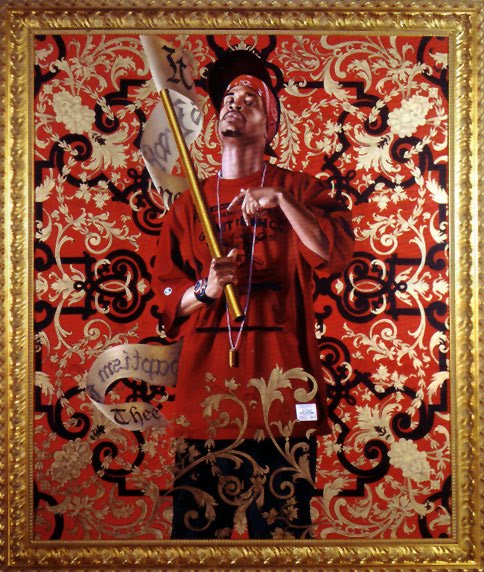

'Untitled' (2009)

Kehinde Wiley was born in the late 70s and is now a well known portrait painter based in New York. His works are very naturalistic, usually portraying urban African men in a contemporary style. Taking men from around the streets of the city and where he lives, renders the models using realistic modes, usually painting them in heroic poses. His works often blur the boundaries between traditional and contemporary representation. Intertextuality is clear in his work as he is constantly referencing well known 17th and 18th century paintings which usually include strong figures from history. For example, Wileys work 'Napoleon Leading the Army over the Alps'' (2005) below directly refers back to the painting 'Napoleon Crossing the Alps' (1800) which was done by Jacques Louis David.


'Napoleon Leading the Army over the Alps'' (2005)

3. Wiley's work relates to next weeks Postmodern theme "PLURALISM" . Read page 51 and discuss how the work relates to this theme.

The postmodernist idea 'Pluralism' relates directly to most, if not all of Wiley's works. Wiley depicts African men with urban attributes such as street clothing etc, and places them in environments where you would usually expect a middle class white man to be depicted. You would expect this because in the past it has only been acceptable to paint white middle class people in the prioritizing places. Nowadays people are moving away from that absurd point of view and are including more varieties of cultural groups, less focus is on single ones.

''Count Potocki'' 2008

4. Comment on how Wiley's work raises questions around social/cultural hierarchies , colonization, globalisation, stereotypes and the politics which govern a western worldview. 

As Wiley grew from painting from photographic portraits of people from his city, his style started to question colonization and politics. Replacing what would usually be a middle class white person, with an African man, he has outlined and described previous problems that are amongst society. He is showing that the different social/cultural hierarchies within our races are all as important as each. I think he has done well to depicted the fact the black people have gained more acceptance into todays society, and that they should no longer be seen as anything less that any other culture. 

5. Add some reflective comments of your own, which may add more information that
you have read during your research.

I think that Wiley's work do a lot for our society in more than one way. His strong beliefs and thoughts are shown well with his referencing, media choices, and his contemporary style. Being someone from a country where racism and exploitation has always been a big issue, his work is very inspiring and paints interesting, deep thoughts in the viewers mind. 


en.wikipedia.org/wiki/Kehinde_Wiley
www.artnet.com/awc/kehinde-wiley 
www.thinkcontra.com/kehinde-wiley-on-current
www.robertsandtilton.com/artists/wiley

ALVC Handbook


Wednesday, 22 August 2012

Post 3: Hussein Chalayan and Postmodern Fashion


1. Chalayan’s works in clothing, like Afterwords (2000) and Burka (1996) , are often challenging to both the viewer and the wearer. What are your personal responses to these works? Are Afterwords and Burka fashion, or are they art? What is the difference?


Hussein Chalayan is a British/Turkish Cypriot fashion designer born in 1970. 'Burka' and 'Afterwords' are two works that would definitely stir large amounts of discussion within the fashion community. The work from the series 'Afterwords' was inspired by the stories of refugees, having to leave their homes in times of trouble. The dress worn by the model was once a table made from circular rings. She steps into the table pulling up the rings, transforming the piece of furniture into a piece of clothing. This transformation suggests the necessity to leave home in a hurry with nothing but your clothes on your back. I think the work is obscure to look at and very hard to see past as an image. If seen as the filmstrip like I did afterwards, your understanding is easier to come by and the meaning and decisions behind the design surface much faster. When looking at it as an image you can see it suggests industrial ideas from the modernest of modern worlds. I think it is clever and the outcome of the pieces was very successful for Chalayan. 

'Afterwords' (2000)

The piece 'Burka' when first seen looks relatively disturbing, looking through the images they would create endless controversy for critics and audiences. This work, to me is definitely crossing the line between fashion and art. The works challenge ideas like modesty, feminity and identity with some models wearing nothing but masks and sandals. To me the work definitely challenges the identity of the female. It looks like he is showing women to all appear to look the same, no matter what the mask is like. 

'Burka' (1996)

I believe 'Afterwords' as a work would be classed as a fashion piece. However 'Burka', I think this work continuously crosses the line between fashion and art. It could be classed as both on many levels. I think fashion should head more towards being something that a person would literally wear, but it seems to be moving further from that. A quote about the difference between art and fashion "Fashion is what seems beautiful now but looks ugly later; art can be ugly at first but it becomes beautiful later." - Mona Simpson. As a piece of work, 'Burka' seems pretty ugly to me.

2. Chalayan has strong links to industry. Pieces like The Level Tunnel (2006) and Repose(2006) are made in collaboration with, and paid for by, commercial business; in these cases, a vodka company and a crystal manufacturer. How does this impact on the nature of Chalayan’s work? Does the meaning of art change when it is used to sell products? Is it still art?

'My work is about ideas. If I had to define my philosophy in just a few words, it would be about an exploration, a journey, and storytelling' - Hussein Chalayan. 

When the links between his works and industry are so strong, I think that to the art world his work would be classed less as art. It would be seen more as a money making exercise being performed. But to the people who try to understand his works meaning and what he has tried to accomplish, the would appreciated it further. Working with a client or a specific reason like advertising for a company would make his process a lot harder and longer.  The construction of the thought bubble behind would be twice as big as a normal work. Overall I think the impact wouldn't be noticed by Chalayan, an audience would look at the work with the thought in mind that 'it is a piece by Chalayan' not that it is a piece of advertising which is why I think he does it. 

 'The Level Tunnel' (2006)

'Repose' (2006)

3. Chalayan’s film Absent Presence screened at the 2005 Venice Biennale. It features the process of caring for worn clothes, and retrieving and analysing the traces of the wearer, in the form of DNA. This work has been influenced by many different art movements; can you think of some, and in what ways they might have inspired Chalayan’s approach?

'Absent Presence' film screened in Venice Biennale, 2005. It is based on genetics, biology and identity. It opens the argument on how certain identities can or cannot adapt to new environments. I think the film was highly influenced by Postmodernism, and of course a lot from the film industry with very realistic and blatant screenplay. He uses a lot of modern society elements such as DNA testing and other technology which shows the influence of the age we live in now. 


Photos from 'Absent Presence' (2005)

4. Many of Chalayan’s pieces are physically designed and constructed by someone else; for example, sculptor Lone Sigurdsson made some works from Chalayan’s Echoform(1999) and Before Minus Now (2000) fashion ranges. In fashion design this is standard practice, but in art it remains unexpected. Work by artists such as Jackson Pollock hold their value in the fact that he personally made the painting. Contrastingly, Andy Warhol’s pop art was largely produced in a New York collective called The Factory, and many of his silk-screened works were produced by assistants. Contemporarily, Damien Hirst doesn’t personally build his vitrines or preserve the sharks himself. So when and why is it important that the artist personally made the piece?

I think it is important for an artist to play a lead role in all aspects of their work, including the production. I believe it gives works much more value, having assistants doing bigger portions than the artist should under/decrease values. If an artist did none of the production, they would be getting constantly judged and phrased for talents that they don't have/didn't do. For example, audiences interested in hands on detail elements could be amazed by parts of a work, giving an artist a high place in their standards when infact that wasn't even their talent in play. To me it definitely completes a work, having the artist playing a lead roll in the production. 


http://usedmagazine.co.uk/?p=1542
http://fashion.telegraph.co.uk/galleries/TMG8459042/1/In-pictures-Hussein-Chalayan.html
http://art100.wikispaces.com/Hussein+Chalayan
http://www.husseinchalayan.com/blog/ 
http://www.designboom.com/eng/interview/chalayan.html 

Monday, 20 August 2012

Post 2: Post Modernism - Ai Weiwei & Bansky

1. Define Post-Modernism using bullet points that include short quotes.
- It is a tendency in contemporary culture characterized by the rejection of objective truth and global cultural narrative.
- Postmodernism is "post" because it is denies the existence of any ultimate principles
- It is associated with relativism, "anything goes".
- Linguistic idealism, as in "reality does no determine language, language determines reality".
- Irony
- Pluralist
- Reflexivity
- Non-universalist people, as in people choose what the want to believe. "Nothing is guiding society's way of thinking".

2. Use a quote by Witcombe (2000) to define the Post-Modern artist.
"The post-modern artist is ''reflective" in that he/she is self-aware and consciously involved in a process of thinking about him/herself and society in a deconstructive manner, "demasking" pretensions, becoming aware of his/her cultural self in history, and accelerating the process of self-consciousness."

3. Use the table on pages 47 and 48 in your ALVC handbook to summarize the list of the features of Post-Modernity.
Postmodernity follows an unclear bases or cultural pluralism where there single road/belief that everyone admits to. The depth of an image is without concern, with more attention being played to the surface of images. It forms a new culture mixing both high and low categories instead of one reigning over the other. It is continuously adapting to visualized media, substituting it for the real. It challenges seriousness, forgetting boundaries which become lost. Brings much more freedom to art, with it being judged and authenticated by an audience made of up everyday people.

4. Research Chinese artist Ai Weiwei's 'Han Dynasty Urn with Coca-Cola logo'(1994)
in order to say what features of the work could be considered Post-Modern.


There is a few features within this work by Ai Weiwei that could be considered 'Postmodern'. Firstly the main feature would be the mixture of two different cultures, mixing an ancient cultural artifact found most commonly in the eastern world with one a well known logo from Coke. The coke logo is one of the biggest known brands of modern society in the western world so you could also say he is blending the western world with the eastern aswell. Another postmodernist feature could be irony as he has taken an ancient urn of high value, and by placing the Coke logo on it, turned it into a ugly, useless item with no longer any value at all. 

5. Research British artist Banksy's street art, and analyze the following two works by the artist to discuss how each work can be defined at Post-Modern.


This work 'Flower Riot' done by Banksy, is of a gangster or a rioter in street clothing, throwing a bundle of flowers. Irony has been used by replacing what would usually be a rock, or a bottle or something, with a bundle of flowers. Instead of the action from this ganster   resulting in violence it will result in peace. This comparison could be portaying a view that tries to remove the seriousness and uncomfort from society.


This work 'Los Angeles' produce by Banksy, is of a caveman carrying a tray of fast food. Here he is again playing with irony which is one of the main postmodern features. A caveman is an early/pre man dating back thousands of years, who is carrying fast food which is one of the modern worlds most used inventions. He could be using this feature to show the slackness of our society today, and how as we advance through the ages, our laziness grows with us. Another feature that could be seen here is the comparison of cultures, comparing ancient pre historic culture of cavemen/neanderthals, with the modern fast food meal which is seen almost everywhere you go in todays society. 


en.wikipedia.org/wiki/Postmodernism
www.spaceandmotion.com/Philosophy-Postmodernism.htm
www.galilean-library.org 
http://www.allaboutphilosophy.org/postmodernism.htm
aiweiwei.com/
http://en.wikipedia.org/wiki/Ai_Weiwei
maryboonegallery.com/artist_info/pages/ai/detail1.html
www.banksy.co.uk/

Monday, 23 July 2012

Post 1: Nathalie Djurberg's 'Claymations'

1. My understanding of the word 'claymation'.
I understand 'claymation' to mean the animation process which incorporates clay models or figurines. The models are manipulated and filmed to produce an image of lifelike movement, usually by a method called stop-motion photography. Each frame, the figurines would be repositioned just slightly so that when the film streamed, the animation would come to life.

2. What is meant by the term 'surrealistic Garden of Eden'? and 'all that is natural goes awry'?

The term 'surrealistic' refers to something that isn't real/unrealistic, like a dreamscape for example, or a distorted/manipulated image. The 'Garden of Eden' in biblical terms was referred to 'paradise', or 'the Garden of God'. It was the place where God put Adam and Eve, the first two human beings. These words 'surrealistic Garden of Eden' refer to the Garden that Djurberg has created. It explains how twisted, distorted and unrealistic her Garden of Eden looks. We usually see gardens to be peaceful, relaxing places but hers is quite the opposite, which is why it is described as 'surreal'.

The words 'all that is natural goes awry' is a link between nature or the living and 'wrong/unpredicted'. The word awry means 'to twist away from the correct course'. Considering Djurbergs works are about sadism and the darker side of the human soul, the words together could mean that nature and all that is living will always astray from the proposed path, sometimes for the worst leading towards death or other negative outcomes.


3. What are the 'complexity of emotions' that Djurberg confronts us with?
When viewing Djurberg's work our emotions get intensely mixed and thrown around. Our imagination is constantly at play, being mixed with scary, horrific emotions and also feelings of happiness and excitement at times. The weirdest of the feelings is that of surprise and unexpectancy, how you are unsure of how to feel half the time, not knowing what is supposed of you. 

4. How does Djurberg play with the ideas of children's stories, and innocence in some of her work?

In a common children's story or tale, the characters are usually first faced with a dark situation and then everything turns happy ever after at the end. Djurberg plays with this idea, reversing the story line, with the happy situations at the start and ending with the dark, horrible situations. She still incorporates ideas of fantasy from children's stories, such as colorfulness and unrealistic features and design. She also still includes the idea of innocence in her work, but not making it as wondrous as in children's books. Making it more of a 'useless' innocence, about how the children are as dark and monstrous as the adults.


5. There is a current fascination by some designers with turning the innocent and sweet into something disturbing. Why do you think this has come about?
I think the nowaday designers and visualists are branching out further, still trying to capture those not seen before ideas, trying to set themselves apart from everyone else. It could be their view of the next step, as we have had our time of the happily ever after tales and need something that excites us in a new way. They could also be using this as a method to show their views on what has happened to society and trying to give the new generation insight into the new disturbing world, trying to rule out all of the fake stuff that is becoming more and more distant.

6. In your opinion, why do you think Djurberg's work is so interesting that it was chosen for the Venice Biennale?

I think it was chosen because it has a dramatic style and difference from the norm. How she has captured the reality of situations in the world, mixing the innocent with dark, terrible situations has created impact. Also how your emotions are twisted and warped when you are viewing, it definitely helps you make more connections with everything that is going on. One of the most contributing factors I think would have been her style and her decisions throughout her process of making. The claymation method and the work behind her modeling has definitely given her work an independent edge, separating it from others and helping her success.

7. Add some of your own personal comments on her work. 

I find her surrealistic style always interesting to explore. The mixture of fantasy design and colourful vs dark sets with her story lines, and also her audio choices aswell, the way she has brought everything together definitely keeps me intrigued. An idea that stands out to me, is how she has reversed the fantasy tales story line from being a happy ending to a dark ending. From this she could be symbolizing how us as humans have almost come to far for there to be any happiness at the end. If this was infact the case I think the new generation will have a more realistic view of life. 


http://en.wikipedia.org/wiki/Garden_of_Edenhttp://www.thefreedictionary.com/awryhttp://artnews.org/artist.php?i=1211http://www.trendhunter.com/trends/nathalie-djurberg#!/photos/47242/1http://en.wikipedia.org/wiki/Nathalie_Djurberghttp://www.designboom.com/weblog/cat/10/view/6886/nathalie-djurberg-experiment-at-venice-art-biennale-09.htmlhttp://londonscrawling.wordpress.com/tag/claymation/http://we-make-money-not-art.com/archives/2009/10/nathalie-djurberg-who-won-the.php

Sunday, 27 May 2012

Post 5: Industrialisation


1. What and when was the Industrial Revolution?
The Industrial Revolution was a period in Europe's history where the discovery of rock, minerals and other materials conjured massive change in manufactural industries. The invention of machinery and enginery meant that the industries could produce development more efficiently and more importantly, faster. This changed the way people lived and has continually brought change to the world ever since. It started in the late 18th century in Britain and near European countries before spreading to the western region of Europe. 

Both paintings featured on this blog, that are from the early 1900s were painted by Modernist painters from the group called 'Futurists'. The Futurists celebrated the machine, and objects in motion. Their primary objective was to depict movement, which they saw as symbolic of their commitment to the dynamic forward thrust of the 20th century.

2. Research both Modernist paintings in order to comment on the subject matter, form and style used to celebrate the machine and motion in each painting. 

'The City Rises' by Umberto Boccioni, 1910.


The main subject matter seen in this work are the horses, the contruction workers, and the construction site in the background. The horses look distressed and in motion as if they are afraid or being startled, and its like the men are trying to do their best to get the horses under control. The style of the painting and palette reflects motion and movement. The quick, somewhat messy and abstract brushwork with the blurring methods help to portray the movement and the fast paced action and development happening around them.


'Dynamism of a Dog on a Leash' by Giacomo Balla, 1912.


In this work by Balla, the subject matter is alot simpler, consisting of only a woman walking her dog through some sort of undetailed terrain. I would have suggested that they are walking relatively fast as of the blurring of the feet. Both the dog and the owner have their feet blurred with repetitions of them in a motion line to show movement. Also the brushwork on the terrain which could very well be a street or just some dirt, creates a blur which also portrays motion, helping show that the subjects are moving at a fast pace. One idea I could see happening would be the low angle of vision, this view makes you feel smaller. This could link to the industrial revolution and how everything is developing at such a fast pace, a small single being such as myself could never have any impact on changing it from taking over everything.

3. Research Cao Fei's RMB City (2007-9)  in order to comment on this work in more depth.
RMB City is a virtual city that Cao Fei created using distinctive imagery from a wide range of Chinas characteristics. It reflects the fluidity of a world in which cultures have mixed and diverged in rapid evolution. The 3D city, named after chinese money, shows a preserve view of Beijing, a blend of communism, socialism and capitalism. She has used images such as a giant shopping cart, filled with skyscrapers and religious moments which is floating in the sea. Candy striped smoke stacks, suggesting the continuous industrial production which is Beijing. There are ships moving in and out of the port which relates directly back to Tianjin Xingang Ports in Beijing. She has also used the famous Tiananmen Square except turning it into a big swimming pool. The reason for her design decisions is because she wanted to create something that responds directly to China's rapid urbanization and the pace of social and economic development.


4. RMB City is described as a utopia/dystopia. Comment on what these terms mean, and how they can be applied to the work.
Utopia refers to paradise alike, or an idealized place or society. Dystopia refers to the complete opposite, meaning an unwanted society or an imaginary place in which the condition of life is extremely bad. I suppose they could both relate to the work in the way that China used to be this 'Utopia' a place of paradise, where everything was nice and perfect. And now it has resulting or heading for the opposide end which is 'Dystopia'. The two are sort of represented in the work as the bright and lively colour representing the Utopia that used to be and the context or everything else showing the Dystopia that the place is now. 


5. Comment on the similarites that you can see in the Modernist paintings and the contemporary digital work that has emerged. 
The main similarity that is present in the three works below is the use of the world they are living in as an idea. They are all in a way, celebrating industrialism or criticizing the effect that it has had on the world we are living in. Another similarity that is evident is the idea of motion or movement. This is clear in Fei's work with the smoke coming out of the pipes, the boats coming in and out of the ports, and also the cars moving to and from. There is evidence of motion and speed in the other works from the use of painting techniques such as the blurriness surrounding the dog. 


http://www.britannica.com/EBchecked/topic/287086/Industrial-Revolution
http://www.investopedia.com/terms/i/industrial-revolution.asp#axzz1w8hZQKnE
http://www.scoop.co.nz/stories/CU0906/S00212.htm
http://www.vimeo.com/4272260

Post 4: Landscape and the Sublime

1. Define the Enlightenment.
The Age of the Enlightenment was a shift in thinking which took place in the 18th century in Western Europe. The philosophical movement focused on looking at the world in a more natural aspect without as much influence from views such as religion and politics. It also had more focus on human reasoning encouraging people to think 'scientifically'.


2. Define the Sublime.
The sublime is an aesthetic concept which originated from ancient Greece, it played an important part in 18th century writings about art. It held a category in aesthetic concepts, in association with the ideas of awe and vastness, which was distinct from the 'beautiful' and the picturesque. Ian Chilvers wrote: "Longinus described the immensity of objects in the natural world, stars, mountains, the ocean, in terms of the Sublime, and from the literary sphere the term was extended to a wider range of aesthetic reactions, in particular the new sensibility for the wild, awe-inspiring, and stupendous aspects of natural scenery." The Oxford Dictionary of Art, 2004. 

3. Explain how the 'Sublime' came out of the Enlightenment.
The main push that resulted in the Sublime emerging from the Age of the Enlightenment was the study of the natural world. People, in the time (18th century), were focusing more on how the world was, naturally, in their own eyes, pushing aside the influences coming from their religious beliefs. 

4. Discuss the subject matter, and aesthetics of Misrach's work, identifying the Sublime.
When looking at Misrach's work, the idea of openess and space is often present. His subject matter is most commonly focused on showing landscapes, using simplistic views to communicate different ideas and concepts. His main choice of matter is stretched land, whether it be sand, dirt, road, water etc always including fair amounts of sky to balance his images. He also commonly includes a small amount of extra features such as mountains in the background, trees, tyre tracks, a building etc. His post processing with his colours and levels is used in a unique way to give his images a surrealist feel making them look more mysterious and magical.

"Misrach uses the lush desert palette to paint an elegant picture of the strangeness and upset balance of human activity in an alien landscape." CAtherine Edelman Gallery

Misrach uses his skills and production in a way to create beauty which relates to the sublime. He captures the sublime of nature, with whichever scene he is working with. Whether it be the beauty of the natural world he is working with, the mountainous landscapes or seascapes, showing the wonderful outcomes of nature. Or if he is working with the terrible scenes that nature has conjured up such as hurricanes. 

5. Add 2 of Misrach's images.

Monolake 2, California. 1999

Wood Scrap, 1990

6. Describe how Misrach's work makes you feel. How does it appeal to your imagination?
When viewing Misrach's work it makes me feel calm, it gives me a relaxed feeling because of all the balanced, calm colours that aren't screaming in your face. Whenever he is using cooler depressing colours they are always dulled to help give the image more positive energy. Alot of his works have a bit of a paradise feeling about them, as if they are showing the untouched wilderness of the world which to me is where I would like to stumble across. In my imagination there always seems to be a surreal feeling when I look at his landscape works. Its as if this is the place where an alien ship is supposed to come and land, or as if it is a landscape of a foreign world. This is manly due to the big open spaces he shows but this definately helps it his work look more magical. 

7. Identify some other artists or designers that work with ideas around the Sublime, from the Enlightenment era as well as contemporary artists.
Giorgione, Ai Weiwei, Andreas Gursky, Claude Monet, Henri Rousseau. 


8. Add a Sublime image of your choice to your blog.

Niagara Falls, Andreas Gursky, 1989.

9. Reference your sources.

http://europeanhistory.about.com/od/referenceencyclopedia/g/glenlightenment.htm
http://smarthistory.khanacademy.org/1700-1800-Age-of-Enlightenment.html
http://www.encyclopedia.com/topic/Sublimity.aspx#3
http://www.edelmangallery.com/

Wednesday, 2 May 2012

Post 3: Ron Mueck's Sculpture and Humanism


1. Mueck's sculpture is described as 'hyper-real'. Define the meaning of this term and explain how it is evident in his work.
The term hyper-real, or hyper realism, refers to visual art which results in convincing illusions of reality based upon photographic images/real life. The definition from thefreedictonary.com and other dictionary sites is: involving or characterized by particularly realistic graphic representation/creating a hyper reality.  

In Mueck’s work, hyper realism is evident. The sculptures of people that he has recreated are extremely detailed and have amazing attention to detail in each area resulting in a highly realistic look. This detail is best seen in the wrinkles, skin lines/curves and folds, and especially in the facial areas. The main, if only fact that departs his work from realism is the sizes of his works. They are either much larger, or much smaller than what they should be if they were real. 

2. Mueck says he is not interested in making life size sculpture. Find out why he is more interested in working with the scale of the figure which is not life size, and mention 2 works which use scale that is either larger or smaller than life.
The main unrealistic fact about Mueck’s works is that they are of unrealistic size. When asked he was quoted saying “I never made life-size figures because it never seemed to be interesting. We meet life-size people every day.” When talking about the size he was also quoted saying “It makes you take notice in a way that you wouldn’t do with something that is just normal.” This means he is more interested in changing the way you look at normal things in life, examples of this are shown in the following images.  


‘Untitled (Big Man) 2000.’ This work of Mueck’s is just over two meters tall, much bigger than it would be if it was to a realistic scale. It is of a big, overweight man sitting in a corner. The main details that are seen when viewing the work is in the feet and toes where there is extreme attention to detail with the wrinkles, creases, toenails etc. If the scale of this work was realistic, this view would have been lost and the detail unexplored.  


‘Two Women, 2005’ This work is about 85cm tall, much smaller than it would be if was in realistic scale. The sculpture is of two older women standing, sort of leaning or hunching over as old people do. They both have the usual old peoples, unhappy with the world/skeptical of everything around them expression on there faces. The smaller scale makes you interpret the work as more of a description, making it easier to explore the women as a description of women then just people.  

3. Define Renaissance Humanism , and identify which aspects of Humanism can be seen in Mueck's work.
Renaissance Humanism was a cultural movement, born from around the 14th- 15th century. It was inspired by classical texts from the ancient Greeks and Romans, offering a different view on life. Renaissance Humanism puts aside religious beliefs and focuses on humans and there values/achievements. Some aspects of this movement can be identified when looking into Mueck’s work. When Mueck’s sculptures people, the realistic details he focuses on portrays the subjects as human beings, however imperfect or unbeautiful they are. He  doesn’t try and show them as something else such as a super human, or a god, or anything else they aren’t. He includes everything including the extreme emotions/facial expressions being shown, and details that you wouldn’t normally look for/ask to see. 

4. Research and discuss one of Mueck's sculptures that you might find challenging or exciting to experience in an art gallery. Describe the work


‘In Bed, 2005’ This work of Mueck’s is massive, about 6.5 meters long, 4 meters wide and about 1.5 meters high. It is of a woman, lying in bed with her head resting on a pillow and her knees up. The woman has her hands out of the bed with one covering her mouth. I reckon this piece would be exciting to experience in real life because of the size. In the picture shown you can see a girl sitting on a chair next to the piece which gives you an idea of how big it really is. I would also love to experience the emotions the girl is expressing as she lies there. Her facial expressions make her look worried, as if a week ago she got the news that she has cancer and is just sitting there, waiting to die. 


http://www.brooklynmuseum.org/exhibitions/ron_mueck/ 
http://sunseven.hubpages.com/hub/Awesome_Sculptures_Of_Ron_Mueck
http://en.wikipedia.org/wiki/Hyperreality_(art)
http://www.sculpture.org/documents/scmag03/jul_aug03/mueck/mueck.shtml